New Opposition in the Middle East by Dara Conduit & Shahram Akbarzadeh
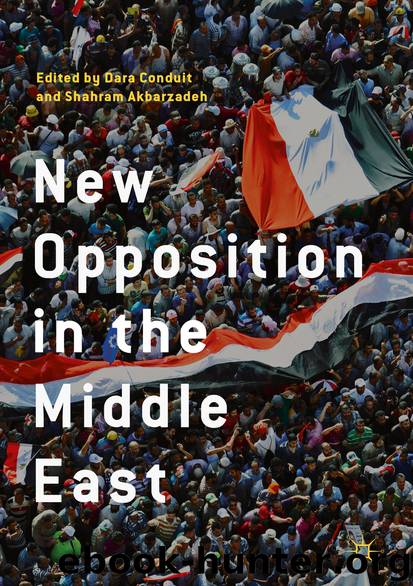
Author:Dara Conduit & Shahram Akbarzadeh
Language: eng
Format: epub
ISBN: 9789811088216
Publisher: Springer Singapore
Al-Wefaq’s five years in parliament closely resembled the experience of a ‘tolerated’ authoritarian opposition , whose inclusion is designed to ease pressure on hybrid regimes to enact genuine democratic reforms, without fundamentally challenging the structure of a political system that favours an unelected executive. The existence of groups such as al-Wefaq, which cannot be conceived of as a loyalist opposition, offers ‘a higher degree of legitimacy to the polity compared to hegemonic, mainly coercive forms of dictatorship.’39 However, given the events of 2011, it is possible that the government overplayed its hand in blocking much of al-Wefaq’s legislative agenda, which prevented the group from presenting its constituents with a sufficient number of concessions to justify its participation in parliament. As Albrecht notes, authoritarian oppositions are typically caught ‘between contestation and complicity’40—they need to be perceived of as maintaining their independence in order to avoid accusations of co-optation, which would threaten the underlying premise of a hybrid regime in the first place. This inevitably requires ‘contentious performances’41 involving moderate opposition to government policy, with the ‘tolerated’ group putting forward an alternative policy platform to that of the government, yet not so contentious that it crosses key red lines such as challenging the structure or legitimacy of the political system itself. Hybrid regimes need to allow the ‘tolerated’ opposition a certain number of victories so that its constituents feel they are benefiting from the hybrid system and perhaps develop a stake in maintaining it. As one al-Wefaq member commented in 2015, ‘fourteen years ago we got a form of democracy. If it was a real democracy we wouldn’t have had an Arab Spring.’42 The Bahraini government’s failure to construct a hybrid system capable of living up to the expectations of openness and consultation fostered by its own NAC reforms arguably led to the eruption of mass pro-democracy protests in February 2011.
Download
This site does not store any files on its server. We only index and link to content provided by other sites. Please contact the content providers to delete copyright contents if any and email us, we'll remove relevant links or contents immediately.
| Anthropology | Archaeology |
| Philosophy | Politics & Government |
| Social Sciences | Sociology |
| Women's Studies |
The Secret History by Donna Tartt(19472)
The Social Justice Warrior Handbook by Lisa De Pasquale(12294)
Thirteen Reasons Why by Jay Asher(9122)
This Is How You Lose Her by Junot Diaz(7057)
Weapons of Math Destruction by Cathy O'Neil(6469)
Zero to One by Peter Thiel(5952)
Beartown by Fredrik Backman(5942)
The Myth of the Strong Leader by Archie Brown(5626)
The Fire Next Time by James Baldwin(5589)
How Democracies Die by Steven Levitsky & Daniel Ziblatt(5332)
Promise Me, Dad by Joe Biden(5230)
Stone's Rules by Roger Stone(5194)
A Higher Loyalty: Truth, Lies, and Leadership by James Comey(5090)
100 Deadly Skills by Clint Emerson(5023)
Rise and Kill First by Ronen Bergman(4906)
Secrecy World by Jake Bernstein(4889)
The David Icke Guide to the Global Conspiracy (and how to end it) by David Icke(4853)
The Doomsday Machine by Daniel Ellsberg(4624)
The Farm by Tom Rob Smith(4612)
